Thursday, January 27, 2022

The Campanis Incident

It was April 15, 1987 when both local South Pasadena newspapers published in "Letters to the Editor" an outspoken statement in reaction to a recent interview of Al Campanis, former manager of the Los Angeles Dodgers baseball team. The interview was conducted by the very popular and well respected news commentator, Ted Koppel, during his April 6, 1987 Nightline show. The interview was to look at the career of Jackie Robinson and give Robinson props for his achievements.

The question from Koppel to Campanis that was the basis of the outroar was, "Why are there no Black managers, no Black General Mangers, no Black owners? . . ." Campanis' response sparked controversy and outcry. Two pivotal quotes from that interview were: ". . . [they are] "highly intelligent, but they may not have the desire to be in the front office." He said, "I know that they have wanted to manage and some of them have managed, but they're outstanding athletes, very God-gifted, and they're very wonderful people, . . .", and “They may not have some of the necessities.”

There needed to be a public response to the Campanis interview. That need resulted in my writing and submitting a Letter to the Editor of both the South Pasadena newspapers, The South Pasadena Review and The South Pasadena Journal. Both papers published the letter verbatim (not edited in any way) in their April 15, 1987 editions. The only difference between the two publications was the heading for the letter and the paragraph breaks. The Review headed it as "Campanis Fiasco: Why Minorities Must Excel" while The Journal headed the letter as "Campanis comments unfortunate".

The letter is re-published here and reads:

[To The] Editor:

The comments of Al Campanis on Monday night were indeed unfortunate for the Dodger company.

Alas, his comments rang true in the hearts and minds of many Americans. Nigrahs, Negroes, people of color, colored, blacks are all names that have been given to those whose skin pigmentation has more tan than others of the human race. Which is exactly what we are, people and members of the collective hman race.

Our wants, desires, ambitions, motivations are identical to those of any other person of similar circumstances whose pigmentation is different from ours.

Economic security, quality education for our children, attractive and comfortable housing, opportunity for advancement, concern for our community and its growth, career (and I must emphasize "career") challenge are all elements which constitute the ladders of our hierarchy of needs as Maslow has defined such.

But our needs exceed these. They extend also into, as they did in 1950, 1966, 1979 and even 1987 (and will be in 1995 and beyond) the need to be accepted on our own merits as people. People who are capable of reasoning out complex problems of society, medicine, law, decorating, music and the arts, as well as sports.

The time for our being subservient in fact and in the minds of others and ourselves has passed. Although the race riots and freedom marches of the 1960s did much for progress in acceptance of blacks, it was and is minimal at best.

The fervor and fever have waned dismally. Acceptance has been slow to take root. Many of those roots have withered and died. The older, deeper roots of the past, of ignorance and fear and mistrust, of the bar against opportunity for proving oneself, of nonadmittance and exclusion, are still alive and growing deeper.

The duty of each and every black and each and every minority member is to strive to prove that our color, the clip of our speech, or the slant of our eyes is not fundamental to our performance or lack of performance.

Nor are these external elements part of our motivation to improve and be a vital part of our environment. Rather, they are a complement and compliment to those very things.

Actually, they are the reasons why in the past we have worked so hard. They are the reasons why in the future we will work even harder to do a superlative job of whatever we dedicate ourselves to.

Very truly yours,
YVONNE LA ROSE

Sunday, July 5, 2020

Justifications of Slavery

A few days ago there was a FB post from someone relating to the historic instances of slavery that stretch not only through time but also cultures and civilizations. The person making the post even justified the institution of slavery based on its discussion in the Bible.

I don't remember what day I read that post. I didn't log a reaction nor comment on it so it's not possible to easily find it again. I don't remember who made the post. I just remember the words and some of the arguments and the dismay it caused me.

My internal arguments with the reasoning grew, line by line. So while the recollection is still burning a hole in my consciousness, let me share a few of my reactions and counter arguments here. I hope they will be enlightening.

Yes, slavery has existed throughout time. It was a way of treating those who were part of the vanquished civilization. Being put into slavery was a means of belittling the survivors of the battles and reminding them (and their progeny) that they were not the superiors. It was, thus, necessary to serve the conquerors and be lowered in the social strata. They had to obey all orders or face brutality or death - or both. Many lost their status in humanity; they were treated as non-human, like herd animals as well as sources of gratification.

When slavery came to the Americas, the kidnapped souls were not even considered citizens of their place of transplant. They were merely merchandise.

The states of the new country (United States) began to enact laws that tended to disenfranchise those who were part of the African Diaspora, as well as the Native Americans. They began to be treated in similar fashion. The laws determined how one was allowed to dress and allowable movement [in both North and South Carolina], what one's lineage was (as a determinant of racial classification and status [see Virginia 1662]). The laws set forth whether neighborhood schools were accessible to the entire population or whether education was even allowed. Some laws forbade doing business with those of the diaspora. And then there were the fugitive laws.

Voting rights were determined by not only those laws but also based on whether one owned land. Voting, you see, was a privilege that was not even available to women until the Amendments of 1964 and 1965.

Perhaps the Facebook commenter's words were part of a response to the current outcry about police brutality. That also has its roots in our history from the slave patrols of 1790 South Carolina. It became a standard. It became the seed for police brutality and excessive force. It seems to have also been the seed for the formation of the Ku Klux Klan's activities.

So to those who attempt to justify slavery, please become aware that slavery - no matter when it occurred or to what culture it affected - was a matter of being subjugated in addition to justification for being treated in an inhumane manner. It became a lifestyle because open objection or refusal to obey was treated with punishment - or death. You see, slaves were quite fungible. Just as we, today, think nothing of what is now called "white privilege" and is taught to young, tender ages as social custom (and merely the way social standards are recognized) is not about privilege but about creating and maintaining an atmosphere of "us" and "them" as well as justification for exclusion.

As to slavery being mentioned in the Bible, even Christ spoke of inhumane treatment and counseled slave owners to be civil with their servants. Also in the Bible we are told slaves had options to buy their freedom or earn it after a period of years. They were not necessarily slaves from the moment of conception until death.

You May Want to Visit:

Wednesday, March 14, 2018

American Negroes and Slavery

Many live very comfortably with the impression that the American Negro race was introduced to the country via slavery and that is the race heritage. It is commonly believed that none of that race ever knew living in this country as a free person was ever a status until the signing of the Emancipation Proclamation. As patronizing and comfortable as that concept is for developing excuses to treat those identified as American Negro (also called African American, colored, and Black) as the pitiful children of Cain, it is not true.

Introduction of Free Men

Research related to producing a month-long Black History Month observance led to exploring the timelines available on BlackPast.org. They begin tracing the history of migrants from Africa back to 1492. Yes, Columbus' journey to the New World. His ship carried not people stolen from their homes for the purpose of creating a workforce of slaves. Instead, these Africans were part of his crew. Furthermore, they did not land in what we call America. They landed in Hispanola or the Dominican Republic. The purpose of Columbus' journey was to open a new industry of plantation slavery.

The next point in time wherein Africans enter the continent is in 1513 when thirty men accompany Balboa on his quest to the Pacific and land in Panama.

We learn of the first free Africans to arrive in the United States in 1540. The expedition of de Soto lost one of its African members when he decided not to return with de Soto. Instead, he remained in the Mississippi River Valley and made his home with the Indians who lived there. The expeditions of Coronado and Alarcon into the New Mexico territory of 1540 also had free Africans among the team of explorers.

And then there's Saint Augustine, Florida where in 1565 a company of African farmers and artisans helped found the city during de Avila's exploration of the territory.

The name Isabel de Olvera may not be one of the better-known in history but her steps in protecting her status as a free woman before making the journey to the New Mexico territory in the de Resa expedition of 1598 is worth noting. Perhaps this was the first time documents relating to one's identity and status was used in the continent. She petitioned for a certified declaration to prove that she was a free women, meaning she was not a slave nor was she bound by the restrictions of marriage.

There is some controversy about Mathieu da Costa, a free Black explorer and interpreter who guided the French through parts of Canada, Lake Champlain, and Nova Scotia during the period of 1603 to 1607.

Jan Rodriquez was a free sailor who was assigned to live and trade with the Native Americans who occupied Manhattan Island in 1613. His employer was a Dutch fur trading company.

William Tucker set a precedent in 1624 by being the first free "African American" child born in the English colonies and be baptized.

Matthias de Sousa was the only Black person to serve in the Maryland legislature in 1641. Before his tenure in the legislature, it is noted that he voted many times. This is a halcyon accomplishment because suffrage for Blacks became encumbered and then banned as time progressed. He arrived in Maryland as an indentured servant to a Jesuit priest. Once he'd worked off his debt, he turned to fur trading.

Black Slave Owners

What may have been the motive behind Anthony Johnson's setting a precedent in 1651 for free Black men to import enslaved Africans is not clear. Perhaps it was being given a tract of land in exchange for the number of slaves who were owned. What is notable is that four years later one of his slaves escaped and Johnson sued for and won the slave's return. The court had previously considered the slave an indentured servant and felt it had no jurisdiction in the matter.

The Developing Industry

The above chronology intentionally omits the instances when intentional importation of kidnapped Africans to the Americas. The reason is to minimize the confusion about what was happening in the new land. The other reason for the distinction is to highlight the two instances of immigration people and their status. To be sure, importation of slaves began in 1625 in the colony of New York. They became what is now considered the first municipal workers.

A Mixed History

Arriving in this new land held options for the new inhabitants. You could arrive as a free person, without regard to race, or you could arrive as an indentured servant. Once your debt was worked off, you became a person free of the debt that brought you to the land. Or you could arrive as one who was enslaved.

What's interesting to learn as one pores through the timelines is that those who were already occupying the land, the Native Americans, became enslaved and treated in a manner similar to the Africans who were imported as slaves. To be certain, there were also Whites who were treated as slaves, not indentured servants. But the details of the White slaves is not provided in BlackPast.org's accounts.

There comes a time when the lines of demarcation begin to blur as civil rights deteriorate. Eventually, being Black become synonymous with being a slave and of slave heritage.

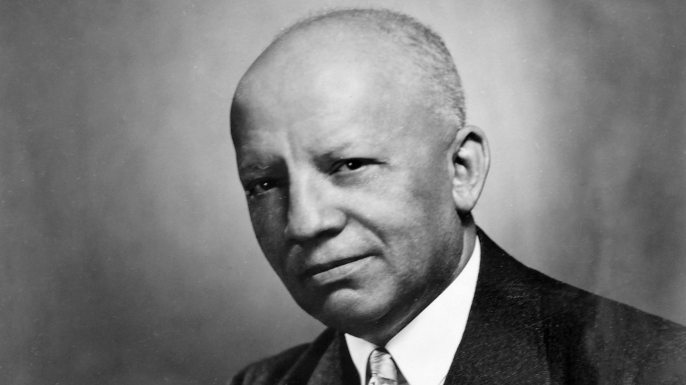
What a checkered history we've woven for ourselves. It appears Carter Woodson very definitely saw the need for an education about Negro history so that those of the race could become empowered and those who are not of the race could become better informed and aware.

More Reading

Saturday, July 7, 2012

Identifying with Pressures - Dido Belle and Mary Seacole

As I prepare to write my sermon for Sunday and the last presentations for Black History Month in 2010, the research is still necessary and progresses. I've shared the return to this plateau of public speaking with my historical novel writers group. In doing so, I've requested input from those who do American re-enactments and those in other countries in regard to the American race experience, especially in regard to the Negro or Black, from their perspectives as re-enacters or natives of other lands looking to America and reacting to its circumstances.

One group member who is in New Zealand shared three names with me. So far, I've only been able to read about the two women, Dido Belle and Mary Seacole. Although Dido experienced extremely similar situations and acceptance with her family as I experience here at The Alhambra, the assisted living and retirement community where I currently reside, it is the impressions expressed by Mary Seacole that evidence how I am feeling at this point in time.

The history expresses:

Later that year Mary followed her brother Edward to the Isthmus of Panama where her medical skills were soon needed for an outbreak of cholera. She also set up a hotel for travellers selling food and medical provisions mainly to the English and the Americans passing through. It was here that Mary had her first experience of the slaves of America and was deeply affected by their treatment.

In 1854 the Crimean war broke out and Mary realised that her skills could be of great help to the soldiers on the front line. She went once again to England and applied to the war office and several other bodies to be sent to the Crimea. She came well armed with excellent references from the many distinguished officers she had helped and worked with over the years but to no avail. Mary began to feel that her colour was hindering her chances.

'I was so conscious of the unselfishness of the motives which induced me to leave England - so certain of the service I could render among the sick soldiery, and yet I found it so difficult to convince others of these facts. Doubts and suspicions arose in my heart for the first and last time, thank heaven. Was it possible that American prejudices against colour had some root here? Did these ladies shrink from accepting my aid because my blood flowed beneath a somewhat duskier skin than theirs? Tears streamed down my foolish cheeks, as I stood in the fast thinning streets; tears of grief that any should doubt my motives.'

Mary was not so easily deterred. Unable to secure a position from the war office, or any other English establishment, she used her own funds to make her way to the Crimea. There she established her own British Hotel and spent the rest of the war tending to the wounded and the sick and providing decent food and shelter to those most in need.

Her words embolden me.

Friday, January 21, 2011

Political Reform Revisited

The dynamics leading up to repeal of the new Healthcare Reform bill have been interesting to observe. Being one who is fascinated by the lessons we can learn from history, it wasn't difficult to see many parallels between Reconstruction Congress and the destructiveness of the current and last one.

In case something was being misinterpreted and twisted from reality, I decided to review some of my Black History materials and compare them with what can be found on the web in regard to the U.S. Congress from the 1860s, also known as the Reconstruction Congress.

The focus is on the newly-installed Black members of this august body. My recollection is that while all 31 Representatives and two Senators were very well educated and capable men, they faced inordinate obstacles to doing their actual work because their challenges were sometimes not so subtle maneuverings to unseat them due to their race. Not to trust memory to this very important issue, I went to Google which pointed me to Wikipedia. My recollection was correct.

There was only one member of the Congress who was also a non-slave electee who seems to have avoided the vitriol. Otherwise, all suffered some type of distraction from their stated duties that essentially tore them away from their jobs, led to Jim Crow, and made them less effective than we (as the country of electors) would have wanted. How similar this state of affairs seems to be to our current Congress and the last session as bi-partisan politics fueled getting Black representatives' having aspersions cast their way to discredit their character and therefore diminish legislation and representation that they backed.

The saying is, "History repeats itself." Perhaps that is why the Healthcare Reform Bill is being dismantled by both parts of the Congress and I struggle to preserve these thoughts. Does this act of destruction (under the guise of insufficiency) portend the removal of Obama and the restoration of a Reganesque/Bush-like administration? And does this mean it will take yet another 100 years to gain any meaningful inroads for those who are American, whether naturalized or natural, to receive any of the fruits of the American Promise?

Friday, October 15, 2010

The Forensic Reconstruction of George Washington, Part 1

Here's another post by guest blogger, Suzanne Adair

How is it possible to forensically create an accurate, life-sized figure of someone long dead without having access to the deceased's bones? The traveling museum exhibit, "Discover the Real George Washington: New Views from Mount Vernon," features three life-sized figures of George Washington at the ages of 19, 45, and 57. To create these figures for the exhibit without exhuming Washington, the folks at Mount Vernon sought the expertise of Dr. Jeffrey H. Schwartz, a forensic anthropologist at the University of Pittsburgh. Schwartz collaborated with at least ten other experts.

Schwartz used a laser technique to scan the three-dimensional life mask, bust, and statue created by Jean-Antoine Houdon when Washington was in his early fifties. The associated computer program captured points and extrapolated them, allowed the team to morph the shape of Washington's face and body according to known physiological data about him at various ages. Schwartz also had access to the following for Washington:
  • His dentures
  • His surviving, unaltered clothing
  • Portraits from actual sittings (v. sightings)
  • Text sources such as letters and diaries that described Washington
GWDentures Several issues affected Schwartz's interpretation of Washington. Tooth loss and use of dentures affect the shape of the jaw and mouth. Tooth loss for the first president started when he was in his twenties. By the time he took his oath of office at age 57, he had only one of his natural teeth left in his mouth and used an uncomfortable set of dentures. This set of Washington's dentures is on display in the exhibit.

Also, Washington had contracted smallpox in Barbados when he was nineteen. No records have been found to indicate the amount of facial scarring that he endured from the disease. However, Schwartz believes that a scar visible on Washington's left cheek in some portraits was from smallpox and not the result of a tooth abscess, as sometimes theorized.
GWPealePortrait 
According to Schwartz, children of the 18th century were corseted from an early age, boys through about their fifth year. This permanently affected the spine's shape and the body's carriage. Shoulders of adult men were brought back and down. The curve of the lower back was accentuated, as was the belly. In this portrait of Washington, you can see those features.
What were the results when Schwartz and his team pulled all of this together? Check back here on Wednesday for a look at George Washington when he was 19, 45, and 57.

Friday, October 8, 2010

Georgian Secrets: Ladies' Undergarments During the American War of Independence

Suzanne Adair blogs at http://www.suzanneadair.typepad.com

She's Clio's guest today cross post blogging about:

Georgian Secrets: Ladies' Undergarments During the American War of Independence

Readers occasionally ask me what ladies of the late 18th century wore for underwear beneath those lovely gowns and petticoats. Did they wear panties? What made their hips so huge and their torsos look like tubes?

On Sunday 19 September, Louise Benner, the Curator of Costumes and Textiles at the North Carolina Museum of History presented the program "From Head to Toe: Clothing in 18th-Century North Carolina." A portion of her program included showing the audience the underclothing beneath the gorgeous polonaise gown that a volunteer named Gina was wearing.

For upper class and many middle-class women, undergarments consisted of the following:

* Shift. Ms. Benner's hand is on the sleeve of Gina's shift. The shift, later called a "chemise," was made of cotton, linen, wool, or silk, had three-quarter length sleeves, and reached to the middle of the woman's calf. Shifts doubled as sleepwear.
* Stays. In the picture, the stays are the greenish garment across Gina's midsection. Stays were heavily boned, usually with whalebone, to keep the torso erect and thus heavily restricted movement in the upper body. Stays also gave women's torsos that "tube" look.
* Panniers. Also known as side hoops, these were tied around the waist. Panniers made the hips look extra-broad beneath the petticoat and lower portion of the gown. If the gown and petticoat were made of heavy material, panniers would be constructed of metal to support the weight of the fabric.
* Pockets. Gina's right hand rests on a pocket, accessible through slits in her gown and petticoat. Women might wear pockets on both hips and/or embroider their pockets. Embroidered pockets could be worn atop the petticoat instead of beneath it.
* Stockings. Made of natural fiber like the shift, stockings were tied with ribbons just above the knee.

A woman such as a laundress who performed physical labor also wore a shift and pockets, but instead of stays and a gown, she wore a short jacket (also called a short gown) with some boning, usually pinned closed across the front. The jacket reached to just below her waist and covered the top portion of her petticoat.

Panties arrived on the underwear scene decades later.

Ms. Benner's presentation was part of a collection of lectures and free programs that supports the traveling exhibition, "Discover the Real George Washington: New Views From Mount Vernon." The North Carolina Museum of History is the only venue in the southeast to host this exhibit, which runs through 21 January 2011. Colonial North Carolina Family Day on 25 September, in which I will participate, is one of the supporting programs.

Monday, September 6, 2010

King Herod and Cleopatra's Daughter


cross-posted from www.stephaniedray.com

Though no ancient sources directly link the two monarchs, it’s difficult to write a novel about the life of Cleopatra’s daughter without referencing one of her mother’s bitterest enemies.

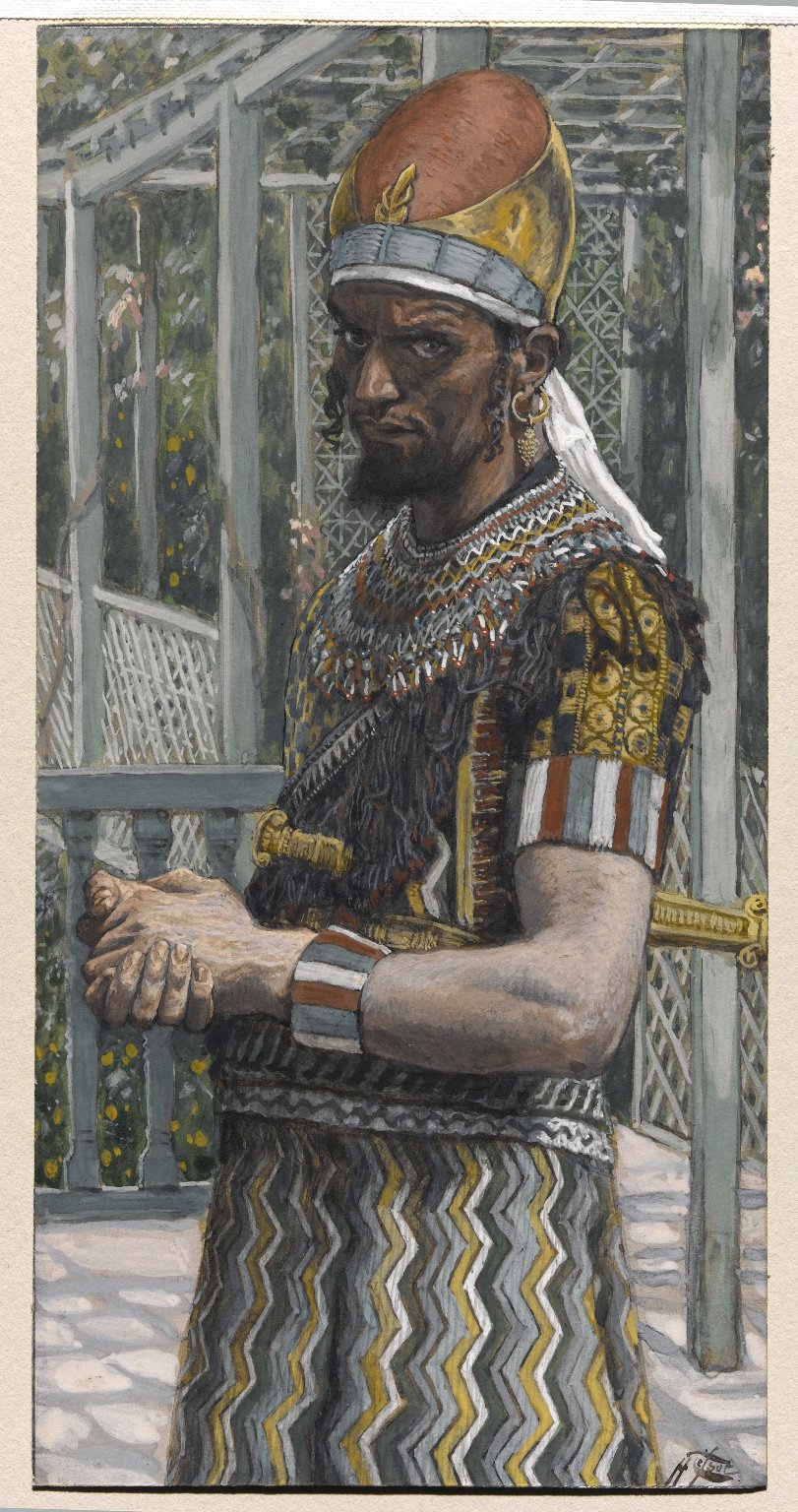
Herod the Great was Cleopatra VII’s rival even before her affair with the Roman Triumvir, Antony. As a Ptolemy, Cleopatra maintained a hereditary claim on Judea, but that wasn’t the only source of her conflict with King Herod.

To say that Herod’s personal life was a study in dysfunction is to put it lightly. When he entered on a campaign to rid himself of his wife’s relatives, of the Hasmonean Dynasty that preceded him, his mother-in-law found a sympathetic ally in Cleopatra VII. The Queen of Egypt tried to intercede on behalf of her friend, and apparently won Herod’s lifelong enmity as a result.

The feeling appears to have been mutual. Cleopatra would later demand from Antony that Herod’s whole kingdom be surrendered to her, but because Herod had been a loyal friend to Antony, he only stripped Herod of date and balsam plantations in Jericho and Ein Gedi.

The rivalry reached such a fever pitch that Herod is said to have considered assassinating Cleopatra, but was dissuaded by his advisors, who assured him that Antony would never forgive him. After Antony and Cleopatra’s defeat, King Herod went over to Octavian, asserting that he had given Antony the best possible advice: Kill Cleopatra.

Did the rivalry end there, or did Herod continue to fear the Ptolemies even after the famous queen took her own life?

Three of Cleopatra’s children survived the civil war: little Ptolemy Philadelphus, Cleopatra Selene, and her twin brother, Alexander Helios. As Ptolemies, all three could exert a claim over Judea, and because they were half-Roman, it might well have been feared that their claims might be supported against Herod if the political fortunes of Octavian should change. Even dead, Cleopatra and Antony still had their partisans, in Rome and elsewhere. Alexandrian cults like those surrounding the goddess Isis still held enormous political sway. If we credit the gospel of Matthew, then we also know that Herod was particularly threatened by children born under auspices and omens, which would have led him to be doubly wary of Cleopatra’s twins.

Given the portrait of Herod that has come down to us through the ages–namely that he was so power hungry and paranoid that he had his own sons put to death as rivals–it is difficult to believe that he ever viewed Cleopatra’s daughter with dispassion. Cleopatra Selene not only survived childhood, but went on to become Queen of Mauretania. Are we to believe that King Herod was not made uneasy to see his enemy’s daughter given more territory to rule than all the other client kingdoms in the empire put together?

Cleopatra Selene and her husband Juba appear to have had the implicit trust of Augustus, and did not need to make frequent visits back to the capitol to secure his good will, but Herod was less secure. Whereas Selene and Juba founded a port city and named it after Caesar, Herod commenced building two such cities, naming them both after Augustus. Whereas Cleopatra Selene and Juba appear to have worked in easy concert with their proconsular neighbors in Africa Novo, Herod was obliged to get permission for his military exploits, and overstepped on at least one occasion, prompting an angry letter from Augustus. Given these tensions, it is hard to imagine that Herod and Selene did not wish one another ill.

However, whether or not an active rivalry between Herod and Cleopatra Selene existed, the King of Judea was a pivotal contemporary figure in her life by which she must have measured most of her accomplishments as a client queen. That Herod comes down to us through history more well-known than Cleopatra Selene is partially a function of her gender, but also because her reign was one of relative peace and prosperity, lacking the big splashy family drama that marked Herod’s rule.

Thursday, September 2, 2010

Troy and Women from Hollywood's Perspective

The movie "Troy" is now 30 minutes into playing out on AMC. Well done movie.

I'm also enjoying Brad Pitt in his portrayal of Achilles. He's a haughty, prideful, resentful young man who bears no loyalty to anyone except, perhaps, to his mother. I like his representation in this movie because he breaks from the static, predictable character acting of all his other movies I've seen since "Thelma and Louise."

Also interesting in this story is finally being able to see all the Greek characters I've read about in mythology and history taking their respective places in time juxtaposed to one another. Things finally come together. Relationships are made clear. I'll probably take the next 1.5 hrs to watch this story play out so that I can see how the history goes with all the parts and pieces put together instead of a bit here and a bit there. These are not people who were scattered across time, mere puppets acting out some mindless tasks. These were people full of feelings, cares, fears, needs for respect and association. They had desires to attain great things in many ways.

One thing I'm finding fascinating in this representation, however, is that Pitt seems to be telling us that Achilles was gay. Of course the Encyclopedia Britannica Junior was going to contain a very sanitized version of his life. But nothing else provided that perspective. It appears one of his lovers was his "cousin" (whose name I didn't catch) but as the story progresses, that concept is downplayed in deference to his finding Briseis and ultimately developing care for her.

From a historical analysis I saw many years ago on a PBS program, there was a discussion of Greek moralities and customs. Because so much emphasis was placed on family and the sanctity of the union, the virginity of the bride, men were allowed homosexual relationships until they were ready to wed. Once married, homosexual relationships were forbidden and the marriage bed was protected from desecration. So also were the young women protected from premature awareness and childbirth too early for the development and successful delivery of healthy offspring. Dalliances were discouraged.

I'm also finding the portrayal of the women and their roles in the household (even if it is the court) is fascinating. There seems to be a lot of liberty and freedom in many ways. Whereas, the knowledge I've been given before seeing this is that women were still subservient but not as much as other civilizations. There's no representation of how women played a role in political strategy and decision making. But then, women were the minor characters in this story. This was a story about how one woman caused a war and the focus was on carrying out the war.

Still, this story says women played a very minor role in life and governing. Why have women been treated as mere public eye candy and baby bearers? They are so essential is bringing about developing our cultures, telling the stories, being in partnership with the work and essential in planning. Yet, here again, they are shown as being the minor characters and mere tools in carrying out the larger scheme of life.

As in my youth, I viewed this movie and got curious about the facts - which were real and which fictional. I don't have a wonderful encyclopedia now. I have my laptop and access to information on the Web. So I went to the story of Achilles that can be found on Wikipedia. Interesting how this movie dovetailed so well with the facts on the encyclopedia.

Saturday, August 21, 2010

The Month to Honor Augustus

cross-posted from www.stephaniedray.com

In 8BC, the month of Sextilis was re-named in honor of Rome's first emperor and we've called it August ever since.

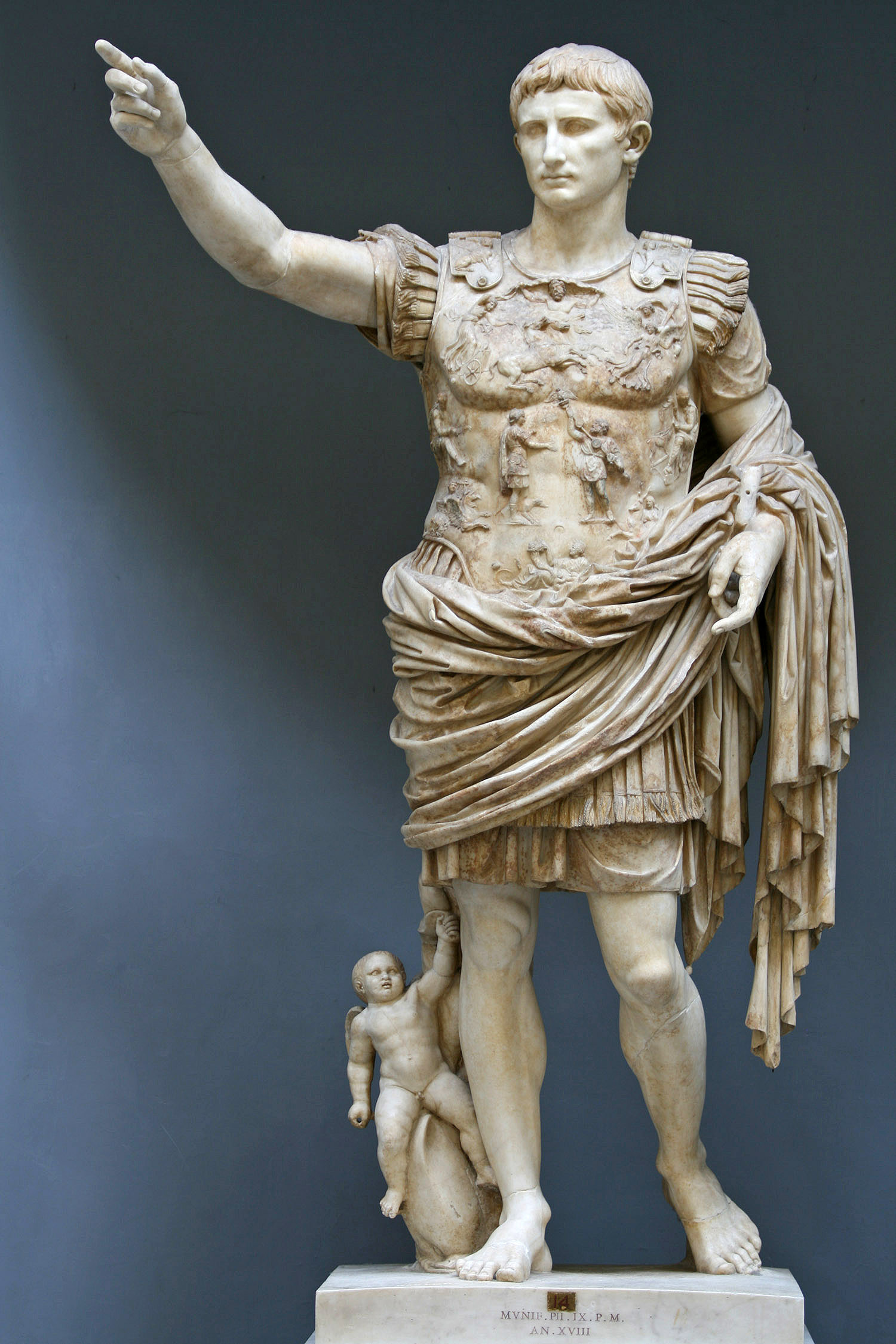
In choosing the month to honor him, Augustus didn't choose the month of his own birth, but rather, the month in which he conquered Cleopatra. Augustus had his detractors, then and now, but it seems only right that we should take this month to celebrate his accomplishments.

Augustus put an end to the civil wars by ruthlessly eliminating all possible rivals. Once he was the unquestioned ruler of the empire, however, he was able maintain a period of relative peace and prosperity for the Romans that lasted more than two hundred years. This became known as the Pax Romana.

A superb administrator, he seems to have attempted to inculcate a love of peace in the Roman mindset that transcended the more traditional aspirations of war-booty and territorial expansion. What's more, unlike his predecessor, Julius Caesar, Augustus had a knack for recruiting men who would not only be useful to him, but also, loyal. Though Augustus wasn't talented on the battlefield, he befriended men of military brilliance, like his school friend, Marcus Vipsanius Agrippa.

Order was the byword of his regime, and he used his authority as "First Citizen" to reform and stabilize the empire. He introduced the notion of publicly funded police and fire fighters. He maintained a standing army to defend Roman territory. He built an unprecedented number of roads and instituted public projects on a scale never attempted before, or perhaps since. He standardized taxation throughout the empire and he restored a great many temples.

Of his most enduring legacies was the effective political use of an appeal to traditional values to silence his critics. Augustus asked the Romans to reform their behavior so as to be in keeping with older and supposedly more simple times. He passed all manner of social legislation that directly interfered with the family lives of his subjects--laws on marriage, adultery, and social obligation. His attempt to transform Roman society was ultimately a failure: within a generation, the debauched days of Caligula were visited upon the Romans. However, the political notion of a culture war endures to this day.

Friday, July 30, 2010

The History of Bubble Gum


Bubble gum was invented accidentally in 1928 by Walter E. Diemer. Here's what Walter Diemer, an accountant at the Fleer Chewing Gum Company in Philadelphia.  In his spare time, he tried out new bubble gum recipes.  Many of them.  But it was his very last experimental batch that was unexpectedly, incredibly different.


It wasn't as sticky as regular chewing gum and it stretched with much ease and great elasticity.   He looked around and spotted a pink coloring, the only one available at the Fleer store rooms at the time.   

At the age of 23, young Walter was excited at his discovery.  To test it out, he took a five-pound glop of the stuff to a local grocery store.  He sold out the entire amount in a single afternoon.

                                                                Original Wrapper

Fleer, realizing their accountant was on to something big, quickly marketed the new gum as "Dubble Bubble." To help sell the new bubble gum, Diemer pent hours training the salespeople on how to blow the perfect bubble so that they could teach their customers.  Dubble Bubble remained the only bubble gum on the market until Bazooka hit the market after World War II.

DUBBLE BUBBLE, the first bubble gum ever and a strong classic property is now owned under the Tootsie-Roll Industries umbrella of popular candies in the Concord Brands collection. The popular bubble gum and its other brands include Razzles, Tongue Splashers, Nik-L-Nip, Wack-O-Wax, Cry Babies and many others.

Tuesday, July 20, 2010

How Did Cleopatra Really Die?

cross-posted from www.stephaniedray.com


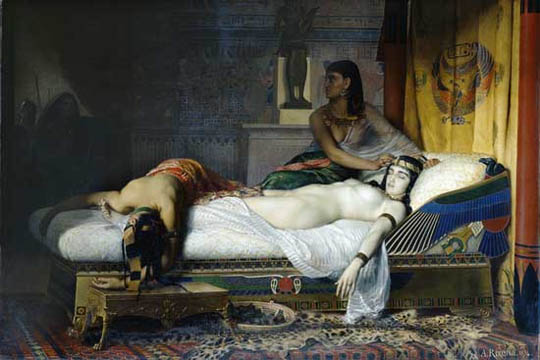
The story of Cleopatra's death, as handed down to us by her conqueror, is that she killed herself by means of a poisonous snake. According to Suetonius, the stunned Octavian summoned snake charming Psylli to suck the poison from puncture wounds found on her arm. Later, she was depicted in a wax effigy during Octavian's triumph with an asp clutched to her breast and contemporary poets like Virgil also alluded to the snake as the instrument of her death.

It could be that they were all wrong. As Plutarch eventually admits, no one knows the truth of how Cleopatra died. Strabo may have actually been in in Alexandria at the time of her death, and he suggests that she may have put poison at the end of a needle. But none of the ancients seem to have favored the idea that she gulped down a poisonous mixture in the form of a drink, so modern claims that there was no cobra and that she drank a poison concoction must be eyed with at least a little healthy skepticism.

It's become fashionable to challenge the manner in which Cleopatra died and also to suggest that she may have been murdered or forced to suicide. It's even theorized that Octavian sent Dolabella to the queen with an elaborate story about how she'd be dragged through the streets of Rome for the express purpose of convincing her that killing herself was the only way to preserve her dignity.

Adherents to these theories point out that Octavian was a master propagandist who wanted to be rid of the queen and was willing to lie about how she died so as to ensure that he'd be held blameless. However, it seems that historians ought to base their conclusions upon more than a belief that Octavian was a liar.

A living Cleopatra was an enormous inconvenience to Octavian. He was undoubtedly better off with her dead than alive. However, it's equally true that there isn't a single ancient source that accuses Octavian of having killed the queen or having encouraged her to kill herself. In fact, Plutarch tells us that Cleopatra was researching painless forms of suicide long before Octavian stepped foot in Alexandria. Moreover, we're presented by an undisputed claim that when Cleopatra was first captured, she was already trying to kill herself with a knife. Even after she was disarmed by Gaius Proculeius, the queen thereupon stopped eating and allowed herself to succumb to illness until Octavian threatened her children. All of this happened before the much ballyhooed talk with Dolabella, and establishes a pattern of suicidal behavior.

Finally, there is the matter of Octavian trying to revive her. Certainly, Octavian was not above play-acting, but this would seem to fit the pattern of historical sources that tell us the queen's death came as a surprise to him.

Like Plutarch, I'll admit that no one knows the truth of how Cleopatra died. But the preponderance of the evidence still seems to be that she took her fate into her hands and ended her own life...quite possibly with the help of a venomous snake. And for purposes of a historical novelist, suicide by snake was good enough for Margaret George, so it's good enough for me!

Monday, July 19, 2010

Meanwhile, Back at the Pipeline

In my last posting, I introduced the concept of conflict and how a writer can't survive without one. In point of fact, each novel has many conflicts - some major and some minor. These drive the plot forward and make what we write interesting. Without conflict, there's no story. Want an example?

Go Fish

Take a short book that everyone read in high school: Hemingway's The Old Man and the Sea. You may have struggled to remain interested while the old man fought the fish. Page after page. That was one conflict: Man against nature. It was also man against himself: the old guy could have tossed in the hook, line, and sinker and decided to start out fresh in the morning. But he didn't.

Without that conflict the story would have read: "Old man takes young boy out on the ocean for a day fishing. Then they go home." Wow. Even Hemingway wasn't that sparse with the prose. With that in mind, let's go back to the Alaska Pipeline and seek conflict.


The Top Ten List

1. Michener would probably have begun with the creation of the universe, but we can start a bit later. Imagine the struggles the first explorers to this territory endured. Perhaps a fissure in the ice unseen by the team and which led to a difficult rescue of one of the essential team members.

2. The team gets lost in a whiteout and is in danger of death by exposure. Perhaps they find an ice cave but it's occupied by a rival team and murder and mayhem break out.

3. Once the find has been recorded, First Nations People object to the rape of the earth. Murder can ensue.

4. Environmentalists and oil company moguls clash over use of this fragile land.

5. Conflict arises within the ranks of the environmentalists over how to fight the pipeline.

6. Conflict arises within the ranks of the oil company over misappropriation of funds.

7. Two lovers murder her husband or his wife (or both)and use the setting to dispose of the body.

8. One of the team members is a deserter from a branch of the Armed Forces and success of the mission could expose his true identity. He works to sabotage the effort.

9. Environmental activists fight among themselves over creating a break in the oil pipeline to create support for their opposition to the project.

10. While digging for the pipeline, scientists uncover evidence of ......... (Fill in the blank)...


Just a few possibilities to mull over. Setting is so much more than time and place.

Friday, July 9, 2010

Conflict

What's the Problem?

You might try to avoid conflict in your life, but if you’re a writer conflict is essential to your story. Without it you’ve got nothing. Blah. Zilch. Nada. The nice part about conflict is there’s so much of it about that you needn’t look to far afield to find some you can use.

Last month I journeyed way north, so far north that I managed to dip my fingers into the Arctic Ocean. That got me thinking about setting and that naturally led to conflict.

Driving from central Idaho to Prudhoe Bay is a journey of more than 3,500 miles and with each degree of latitude ticked off, the country grows wilder and less civilized. That’s a good thing to my way of thinking. Conflicts abound throughout the civilized or semi-civilized world, but once you get to meet nature in the raw, so to speak, conflicts become more elemental in both senses of the word. They’re more basic and they tend to involve the elements.

Back to Basics

Two basic conflicts come to mind here in the Arctic: Man vs. Man – although today that would also read Woman vs. Woman - and Man or Woman vs. Nature. Jack London used the latter conflict in the short story “The Call of the Wild” but the former intrigues with possibilities galore. Here’s just one.

Got Oil?

The Pipeline snakes its way from Prudhoe Bay all the way to Valdez, from coast to coast and bisecting the entire state of Alaska. Why? To feed the nation’s appetite for gasoline and other marvels of petrochemical science is the obvious answer. But the conflicts underlying this massive undertaking present a rich resource for the historical novelist.

Brainstorming

I’m going to come up with a list of ten possible conflicts that could become possible story options. I’ll post these next time. In the meantime, why not come up with your own list and we'll see how they compare.

Wednesday, July 7, 2010

Classic Love Song

A lot of songs have been going through my head for the past week or more. Some of it is classical music but on it's face it wouldn't be classified as classical. Nevertheless, tonight I'm collecting them and storing them on my profile page so that they can live in a place where they can be remembered as classics and contrasted against other things that can be considered classic. They're also shared in this post as hyperlinks to YouTube. Right click any of the links and select your preference on how to open it so you too can experience the rendition of the recording.

One of the songs is by one of my favorite composers, Stravinsky! (No, but I can't remember his name right now. I'll say it in a minute.) "I Loves You Porgy," is the song. It's one of those classic love songs. The version that keeps going through my head is the very soulful one by Nina Simone. I found that one (actually, two versions by Nina) but I also found one version of it by "Billie Holiday. I Loves You Porgy

Now Billie is one of those singers who makes it difficult for me to listen to what's being sung. But people rave about her and her singing even now. (Her professional nickname is "Lady Day.") So I endeavor to listen and learn to appreciate whatever it is they're hearing and the concepts she embodies. Given what Bess is singing about, it seemed quite ironic that Billie Holiday should be singing that song.

She and Bess faced the same type of Sportin' Life who lured her down a dark, dangerous, and deadly path. Unfortunately, there aren't many who are able to travel that road without getting singed. Holiday became one of those tragic statistics of both the Road to Fame and the Road to Sportin' Life. It seems to be a classic story. But her quiet, innocent veneer was not a facade. It was more legitimate than anything else about her life.

What I saw as I watched the video was a woman who merely sang the words and notes, bereft of any emotions, bereft of any attachment to the meaning they hold. She was just quietly crooning a tune. That approach, however, was quite effective when I watched her sing the notorious "Strange Fruit." That song's theme is so horrific that most likely the only way to deliver it is with the same quiet innocence she employed. Anything else would be overkill. It has become a classic presentation.

Nina Simone's version haunts you. You hear the anguish, the woman's soul torn in twain for the man she loves compared with the man who brings her the symbolic love from which she wants to be torn.

Nina has two versions. One is from 1962 from 1962 which is an interpretation of not only Bess's song but a progression through several of the songs from the opera before moving into her love song. I didn't think I'd care for it. But as she moved into the close, it became a definite love song to Porgy, her strong vocals reaching out to her man as she promises him what she will do while they're together.

Overall, the version I still like best, the one that runs through my head tonight and is the symbolism of the dilemma that plagues Bess, is the one she sings in the single version (not the collage) of the classic love song to Porgy. I Loves You Porgy by Nina Simone It isn't Sportin' Life of which she sings, but what Sportin' Life has to offer. It's the craving that gets instilled in what he offers that becomes the irresistible magnet in spite of how strong her love for Porgy remains.

George Gershwin wrote the opera "Porgy and Bess," not Igor Stravinsky. They're amazing composers, each in his own right. While both are two of my favorite classical composers, they provide us with strikingly different perspectives of classical music as well as how it affects our thoughts and ideas.

I love diversity everywhere it's found.

Saturday, July 3, 2010

Rashi, an 11th-12th Century Talmudic Scholar

By Nan Hawthorne, Random Biographies

The author of the first comprehensive scholarly commentary on the Talmud1, and considered the father of all that came after, Shlomo Yitzhaki (or "son of Yitzhak") was a French rabbi better known by the acronym Rashi (RAbi SHlomo yItzhaki). He was born in 1040 AD in Troyes, Champagne. His father, a vintner, was his first Torah2 teacher, but on his death Rashi found other scholars in both Troyes and Worms. The tradition in which he studied was rich in understanding of the meaning of the Torah and Talmud, paving the way for his own works that are both profound and accessible to beginning students.

At 25 he moved back to Troyes where he was made a part of the rabbincal court and later named to head it. He established a yeshiva3 there in 1070 that drew many disciples. In 1096 Mainz Jewish population was massacred by members of the People's Crusade, and Rashi wrote several Selichot4 mourning the slaughter. In addition seven of Rashi's Selichot still exist, including Adonai Elohei Hatz'vaot5, which is recited on the eve of Rosh Hashanah6, and Az Terem Nimtehu7, which is recited on the Fast of Gedalia8.

Rashi died on July 13, 1105, and was buried in Troyes. The site was lost, but was again discovered by more recent scholars and now bears a memorial to Rashi.
Rashi's commentary on the Tanakh9 — and especially his commentary on the Chumash10 — is the essential companion for any study of the Talmud at any level. Drawing on the breadth of Midrashic11, Talmudic and Aggadic12 literature (including literature that is no longer extant), as well as his knowledge of grammar, halakhah, and how things work, Rashi clarifies the "simple" meaning of the text so that a bright child of five could understand it. At the same time, his commentary forms the foundation for some of the most profound legal analysis and mystical discourses that came after it. Scholars debate why Rashi chose a particular Midrash11 to illustrate a point, or why he used certain words and phrases and not others. Rabbi Shneur Zalman of Liadi wrote that “Rashi’s commentary on Torah is the ‘wine of Torah’. It opens the heart and uncovers one’s essential love and fear of God."  Wikipedia13
His three daughters were also Talmudic scholars and married to the same. You can learn more in Maggie Anton's "Rashi's Daughters" trilogy: Rashi's Daughters, Book I: Joheved: A Novel of Love and the Talmud in Medieval France, Rashi's Daughters, Book II: Miriam: A Novel of Love and the Talmud in Medieval France, and Rashi's Daughters, Book III: Rachel: A Novel of Love and the Talmud in Medieval France.

Glossary and notes

1  Talmud:  The collection of ancient Rabbinic writings consisting of the Mishnah and the Gemara, constituting the basis of religious authority in Orthodox Judaism.  The Mishnah  is the first section of the Talmud, being a collection of early oral interpretations of the scriptures as compiled about a.d. 200.  The Gemara is the second part of the Talmud, consisting primarily of commentary on the Mishnah.
2  Torah:  The first five books of the Hebrew Scriptures.  (Sometimes called the Pentateuch.)
3  yeshiva:  An institute of learning where students study sacred texts, primarily the Talmud.
4  Selichot:  penitential poems and prayers, especially those said in the period leading up to the High Holy Days, and on Fast Days. The Thirteen Attributes of God are a central theme throughout the prayers.
5 Adonai Elohei Hatz'vaot:  Selichot recited on the eve of Rosh hashanah.
6  Rosh Hashanah:  commonly referred as the Jewish New Year (literally translated as "head of the year").
7  Az Terem Nimtehu:   Selichot recited on the Fast of Gedalia..
8  Fast of Gedalia:  a Jewish fast day from dawn until dusk to lament the assassination of the righteous governor of Judah of that name, which ended Jewish rule and completed the destruction of the first Temple..
9  Tanakh:  Bible used in Judaism
10 Chumash:  a Hebrew word for the Pentateuch, used in Judaism.  (See Torah.)
11 Midrash/Midrashic:  a Hebrew term referring to the not exact, but comparative (homiletic) method of exegesis (hermeneutic) of Biblical texts, which is one of four methods cumulatively called Pardes. The term midrash can also refer to a compilation of homiletic teachings (commentaries) on the Tanakh (Hebrew Bible), in the form of legal and ritual (Halakha) and legendary, moralizing, folkloristic, and anecdotal (Haggadah) parts.

12 Aggadic:  refers to the homiletic and non-legalistic exegetical texts in classical rabbinic literature - particularly as recorded in the Talmud and Midrash. In general, Aggadah is a compendium of rabbinic homilies that incorporates folklore, historical anecdotes, moral exhortations, and practical advice in various spheres, from business to medicine.

13  http://en.wikipedia.org/wiki/Rashi

Glossary definitions primarily from The Free Online Dictionary.

Thursday, June 24, 2010

Can the language of historical fiction ever be ‘authentic’?

One of the enduring debates among writers of historical fiction is: to what degree can we legitimately - or even intelligibly - use language or literary forms authentic to a given period?

Anyone who has struggled through Peter Ackroyd’s lusty archaisms in The Clerkenwell Tales (14thc) - or the crabbed typography of Hawksmoor (18thc) - might agree with Roland Barthes that fiction comes in just two genres: writerly and readerly.

The first is sipped slowly and savoured for its language tricks and droll conceits. The conjuror is visible everywhere behind his smoke and mirrors. The second is consumed at a gulp, then left behind on a deckchair as a tip for the beach attendant. If the former is published at all, it wins an obscure award from a little magazine and is remaindered within three months. The latter pays the rent.

Yet I firmly believe - although I cannot prove it - that a silent minority of erudite readers is now on the march. No longer will they suffer linguistic howlers, such as Anya Seton immortalised half a century ago in Katherine (1954). The novel has been rightly acclaimed for its attention to historical detail yet in a random sample of some 5000 words (pp. 41-53), I noted ‘scrawny’ M19, ‘coquetry’ M17, ‘chunky’ M18, ‘tawdry’ L17, ‘apoplectic’ E17, and ‘fiddlefaddle’ L16.

Granted, only a pedant would challenge such trivia. How else can an historical writer communicate with a modern reader, except in a modern idiom? (How otherwise could we write a novel set in ancient Rome? Or Ming dynasty China? Or the paleolithic era?) The reader tacitly accepts that the author must write from an atemporal perspective, separate from the period.

But reported speech is another matter, when a story is set in a relatively recent period of English history. I would contend that Seton’s use of the mid-19th century idiom ‘such a mollycoddle’ (p. 372) in 14th century dialogue - when the currency then of both ‘molly’ E18, and ‘coddle’ E19 is implausible - is a howler. This is just one of several examples.

If Katherine was a pantomime like The Other Boleyn Girl, it wouldn't matter. But Seton's work is, in all other respects, brilliantly researched. So the howlers show.

Is this mere hair-splitting? Does the reader really care if, for example, we put the term ‘mob’ (L17) into the mouth of a Shakespearian poet? Yes, I think that - increasingly - s/he does. An habituĂ© of historical fiction often becomes an expert in a given period. Howlers throw readers out of our story - and result in our books being thrown at the wall.

Of course, the ‘expert’ reader may be wrong. Dictionaries are fallible. They cannot attempt to record every word that was ever spoken or written so they can only guess at the date of its first use. For example, the OED credits Lewis Carroll with the coinage of the term ‘chortle’ (chuckle+snort) (L19). Yet a similar word ‘snortle’ (snort+chuckle) was in common use in the late 16th century. So, almost certainly, was the term ‘chortle’.

The few records that have come down to us, and their words, are the unrepresentative survivors of a massive shipwreck.

Yet... the author is not exonerated from the test of plausibility. If the reader detects a linguistic howler in our work (although the reader may be wrong), the illusion is shattered. When I had a character in my last Elizabethan novel abandon his ‘go cart’ to ‘jet’ about Europe, arrive in England by ‘bus’, take his ‘train’ to Slough, then leave his ‘car’ at Ivinghoe, some critics chided me for my anachronisms.

Nonsense! I was simply being faithful to the everyday language of the 1590s when such terms, surprisingly, were also associated with transport. The truly erudite reader, I felt, would have understood (and chortled). But s/he didn't. In the reader's view, I had committed five howlers.

Needless to say, most historical novelists don’t give a toss for this debate. If the story entertains, the supermarket book shopper - who wouldn’t know a solecism from a bogof - is satisfied. And novelists can pay their rent.

Alas, I do give a toss. In a silly quest for fidelity in period language, I once compiled a thesaurus. I took 799 modern headwords - eg. ‘fool’ - and linked them to some 6000 equivalent words and phrases from the 16th and 17th centuries. (You never know when you might need the term ‘noodle-pate’, if only for purposes of self-description.)

You can download my Little Lexicon of Jacobethan Words here without charge: The Lazy Professor. Of course, if you do, you will be at serious risk of having your next novel thrown at the wall. But for all the wrong reasons.

Tuesday, June 15, 2010

Women's Struggles and Sacrifices

It's a little after 3:30 PM here and I'm sipping the last quarter of my comfort mug of breakfast coffee. I finally succeeded, after three attempts, in actually arising and staying out of bed at 1:10 PM. The laundry still sits next to me in the over-sized bag I use to take it into the basement where the on-site laundry is located. It's been patiently waiting since it was organized on Saturday morning.

Yesterday I finally understood the symptoms. Sometime between one of my risings and about an hour ago, I started putting these dynamics together like rails on a picket fence. Parallels of women in history who strove against the odds and how they felt about their circumstances, the prices they were paying -- and still are. Some of those heroines were recorded and acknowledged for their efforts, some not. The totality of them are now my sisters, grandmothers, aunts, and cousins in time and women's issues and feminism. They are my predecessors and I am the predecessor of the ones who come after me who have not yet learned the lessons of the extra effort to be a notable woman for your value and efforts and how to be recognized and acknowledged, even by some small audience, for having allowed your cup to spill over.

Right now I understand the difference between the glass half full and the glass half empty. It is half full because it is constantly being replenished. Therefore, it is never depleted and is always in some state of being full. The glass half empty started as full (maybe even more than full) but is constantly being depleted. There's nothing or only drops that attempt to refill but it is insufficient.

Recollection of the story of Mary Wollstonecraft comes to mind, especially her last year, in light of the radical political philosophies she promulgated. She struggled and strove to get her manuscripts not only published but also be paid for her efforts so that she could survive as well as care for her child. One sacrifice after another she made. First, sending the child to another family so that she would not have to endure the starknesses, the want, and the deprivation of existence that loomed for her mother. Unfortunately, the child (Mary Bysshe Shelley) and especially her older sister did not understand the sacrifices and thought herself a monster who had been rejected. But even in her state of depression, she gave birth to such rich literary classics.

Recollection of those two also calls to mind the unrecorded and timeless histories of mistresses throughout the ages of slave masters. These women obediently gave their bodies to endless days of labor in the house only to find themselves gratefully giving their bodies throughout the night. They were grateful that those were the payments for not being thrown into the streets to fend for themselves with no means of support or else killed for failure to submit. At any rate, they were spared their lives at the cost of their souls.

Some remembered how to sing and did. Some remembered the beauty of their surroundings and sucked them in at every opportunity. Little things gave a bonus to watching the sun rise each morning and offer an Amen as it set at night. On occasions, the one of her heart held her close and poured his life into her loins; she had the joy of remembering that there really was Life and tenderness and grace and meaning to the constant struggle.

What would have happened and where would we be had those women said "No" to the oppression, "No" to the repression, "No" to the cruelty, "No" to the ridiculous, and "No" to the insidious? I dare say it would be like the night skies without the multitude of stars because we would have none of the heroines, sung and unsung, as our guide stones.
Hard was thy fate in all the scenes of life
As daughter, sister, mother, friend, and wife;
But harder still, thy fate in death we own,
Thus mourn'd by Godwin with a heart of stone.
(from "Wollstonecraft and Fuseli" by British poet Robert Browning and that by William Roscoe)

Viva
Yvonne LaRose, CAC

An Anglo Saxon Riddle

he people of Anglo Saxon England loved riddles. The telling and solving of these early interactive poems was a major source of entertainment for young and old around the campfire or fire pit, and luckily for us many such riddles were recorded in The Exeter Book. Here is just one of 91 such which you can find in Old English and Modern English at http://www2.kenyon.edu/AngloSaxonRiddles/texts.htm.

Riddle 37

Writings reveal this creature's plain
Presence on middle-earth, marked by man
For many years. Its magic, shaping power
Passes knowing. It seeks the living
One by one, winds an exile's road,
Wanders homeless without blame, never there
Another night. It has no hands or feet
To touch the ground, no mouth to speak
With men or mind to know the books
Which claim it is the least of creatures
Shaped by nature. It has no soul, no life,
Yet it moves everywhere in the wide world.
It has no blood or bone, yet carries comfort
To the children of men on middle-earth.
It has never reached heaven and cannot reach
Hell--but must live long through the word
And will of the king of creation's glory.
It would take too long to tell its fate
Through the world's web: that would be
A wonder of speaking. Each man's way
Of catching the creature with words is true.
It has no limbs, yet it lives!
If you can solve a riddle quickly,
Say what this creature is called.

Riddle 71

I grew in the ground, nourished by earth
And cloud-until grim enemies came
To take me, rip my living from the land,
Strip my years-shear, split, shape me
So that I ride homeless in a slayers hand,
Bent to his will. A busy sting,
I serve my lord if strength and strife
On the field endure and his hold is good.
We gather glory together in the troop,
Striker and death-step, lord and dark lunge

My neck is slim, my sides are dun,
My head is bright when the battle-sun
Glints and my grim loving lord bears me
Bound for war. Bold soldiers know
That I break in like a brash marauder,
Burst the brain-house, plunder halls
Held whole before. From the bone-house
One breaks ready for the road home.
Now the warrior who feels the thrust
Of my meaning should say what I'm called.

Find the solutions at the very bottom of the right hand column on Nan Hawthorne's Booking History.

Monday, June 7, 2010

Weather and History

We've been slogging through an exceptionally wet spell, here in Idaho, and having noticed my mood has been going distinctly south more and more each day that there's no break in the rain, that got me to musing about the effect weather has on history. That's an exceptionally long introductory sentence, as I look it over, and it seems that the weather is having a draggy effect on my writing as well.

SAD (Seasonal Affective Disorder) is a recognized medical condition characterized by feelings of depression, malaise, and fatigue. It appears that lack of sunlight can cause a host of negative physical symptoms and the treatment is exposure to sunlight. Actually, there's a great deal more involved, but sunlight is key to regaining a sense of metabolical equilibrium.

However, too much sunlight can trigger another set of physical problems, ranging from sunburn to skin cancer. Again, it's finding the proper balance that seems to do the trick.

The Historical Connection

And now for the tie-in to history. What affects one individual also affects collections of individuals and when it's the weather that's the catalyst, people can get downright cranky. In fact, they can get rebellious.

July 4, 1776 - The signing of the Declaration of Independence and the beginning of the American Revolution.

July 14, 1789 - Storming of the Bastille and the beginning of the French Revolution.

These two examples of the long, hot summers of rebellion make me wonder if the heat took its toll on the populace and one more hot day was the proverbial straw.

The Exception that Proves the Rule

Aha! You say. But what about the Russian Revolution that began in February 1917, eh? No problem there. Have you ever been in Russia in the winter? Dark days, no sunlight, and unrelenting cold and snow and ice and sleet. People were getting antsy. They knew what was coming and had to do something to get rid of the angst that was building up inside. No better way toward catharsis than toppling the government.

Anyhow, just a few thoughts on how weather may have been a silent (or not so silent) partner in some major historical events. Anyone have any other events you can link to Mother Nature?
 

Back to TOP

Glamour Bomb Templates